-
Shōfuku-ji Graveyard「Sōbon」
-

-

-

-

-

-

-

-

-

-


-

-

-

-

-

-


-


-

Shōfuku-ji Graveyard「Sōbon」
Mismatch Between Cemetery Forms and Social Structure
When viewing temples in urban areas on Google Maps’ aerial photographs, one is often surprised by how the size of the cemetery far exceeds that of the temple precinct itself. It is not difficult to imagine that these vast cemeteries encroach upon the precinct and affect its sacredness. Zooming in reveals blank patches within the neatly ordered plots—evidence of grave closures—giving the cemetery a mottled appearance. Street View shows long, imposing walls shaped by local regulations, exerting significant pressure on the streetscape.
In recent years, Japan’s annual number of deaths has continued to rise and is expected to reach 1.6 million by 2040. Despite the increasing demand for burial facilities, mismatches between the traditional temple–parishioner system inherited from the Edo period and the realities of modern society—shrinking household sizes, declining ancestral worship, and demographic shifts—have resulted in these landscapes and a breakdown in the system’s functionality. In response, the project seeks to establish a burial facility suited to contemporary social and familial conditions, while restoring the sacred nature of temple precincts and contributing positively to the surrounding streetscape.
Layout Planning Using Polygonal tessellation
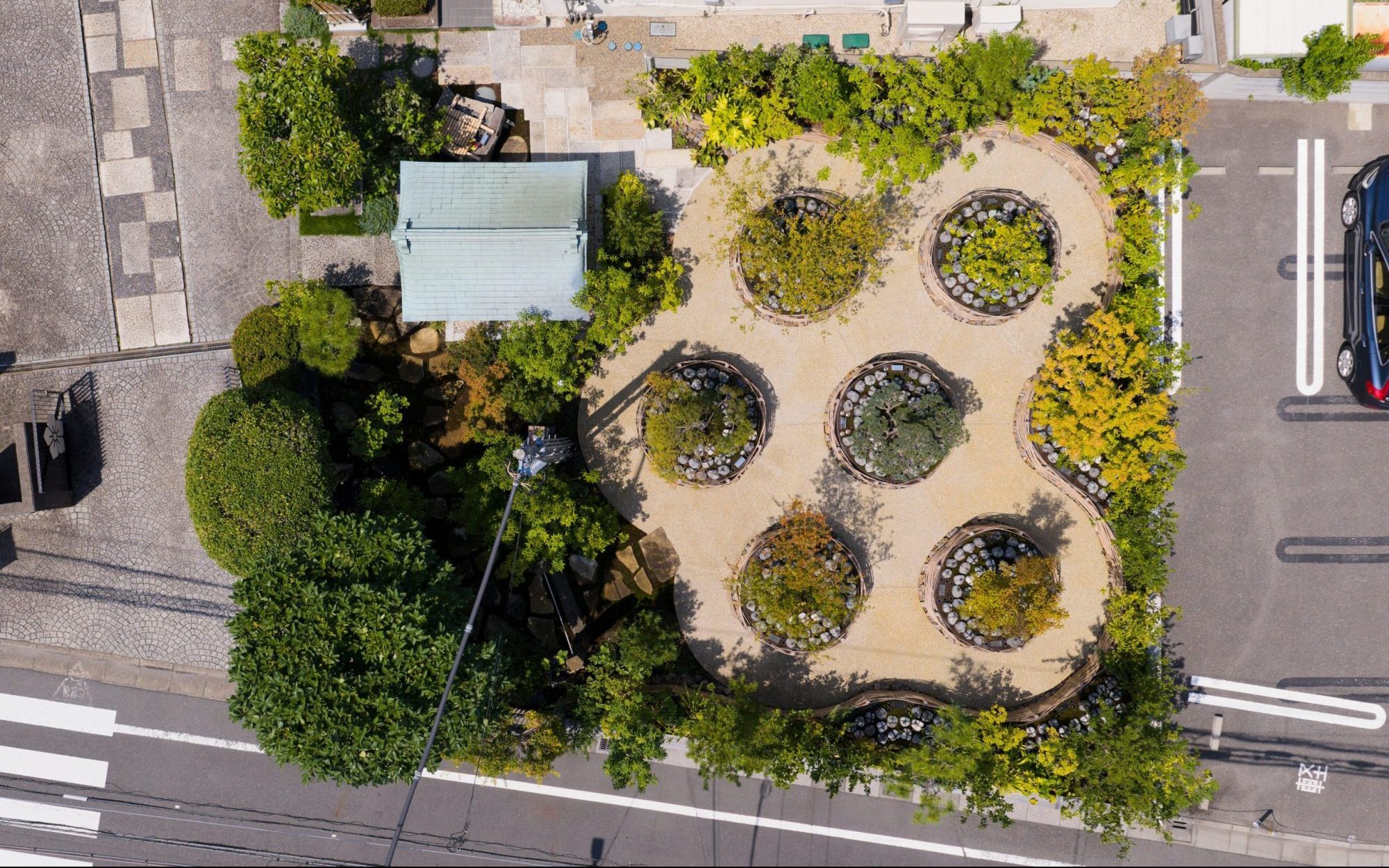
Available land at urban temples is extremely limited. At Shōfuku-ji in Sumida Ward—the site of this project—an area of about 100 m² within a parking lot needed to arrange 461 plots for a tree-burial cemetery. A basic tree-burial arrangement consists of a grave marker in front and a commemorative tree behind. When aggregated, the most rational form becomes a circle centered on the tree. The diameter of the circle was set at 800 mm to house the rootball of a 2-meter tree. Around it, gravestones made from roughly 200 mm natural stones were placed in three rows—the limit for maintaining visual readability of inscriptions—resulting in a 2300 mm–diameter “island,” including the surrounding fence.
These islands needed to be packed as densely as possible into the 100 m² site while ensuring 1-meter-wide pathways mandated by regulation. Mathematics proves that the polygon that minimizes outer perimeter when tiling a plane is the regular hexagon. By arranging the burial islands on a hexagonal grid, we maximized the number of plots while minimizing pathway length. Even the cape-like protrusions along the periphery were used as additional plots. The flower and incense stands placed at each island or protrusion are staggered so that visitors do not face one another back-to-back.
A Stroll Garden as a Key Element of Temples Traditional temples have historically created depth and maintained spatial sanctity by layering their temple complex layout with accompanying gardens, approach paths, and supplementary features such as green spaces, terraced slopes, gates, doors, fences, lanterns, and water basins—all suggesting a sacred boundary. In urban temples, however, shrinking grounds and expanding cemeteries have made it increasingly difficult to maintain this sacred depth. Therefore, although Graveyard『Sōbon』is a cemetery, it was planned as a stroll garden attached to the temple precinct.
Moss-covered stepping stones and a pair of stone pillars bound with rope form a boundary between the precinct and the burial area. A sekimori-ishi stone—tied crosswise with palm rope—creates another boundary: above it lies the living world covered with plants, and below it the realm of death represented by the burial chamber. These layered boundaries help preserve the sense of sacredness. The fences around each burial island are made of shigaramitake, utilizing the flexible and resilient structural properties of bamboo. Damaged slats must be replaced frequently, so newly green bamboo appears intermittently, ensuring Graveyard『Sōbon』is never the same at any moment.
Evoking the Atmosphere of Edo in the Urban Streetscape
Shōfuku-ji is located in an area once known as Edomae, where a few remnants of its historical character—such as traditional restaurants—still survive. It is believed that tea gardens with Kenjinji-style fences and sekimori-ishi once dotted the townscape. By composing the tree-burial landscape from such fragments of Edo culture, the project seeks not to enclose the cemetery within plain walls that turn away from the city, but instead to allow it to participate in the streetscape as an expression of wabi-sabi and the refined sensibility of Edo aesthetics. Passersby seeing trees extending above a Kenjinji-style fence would never imagine it to be a cemetery.
Shōfuku-ji Graveyard「Sōbon」- Location:Tokyo, Sumida-ku
- Programme:Graveyard
- Construction Area:149.27㎡
- Completion:November 2024